
When a product has 47,000 Amazon ratings and a 4.5-star average, the natural response is to trust the crowd. I understand that instinct. But here is what I have noticed after testing travel gear across dozens of trips: the people who leave five-star reviews are almost never the people who pushed the product hardest. They are the people who used it twice on a weekend trip to Nashville and loved it. The people who took it to Morocco for two weeks and had nuanced feelings about the strap rarely come back to update their review. So before I tell you whether the WATERFLY RFID crossbody sling bag is right for you, I want to tell you what the star count cannot.
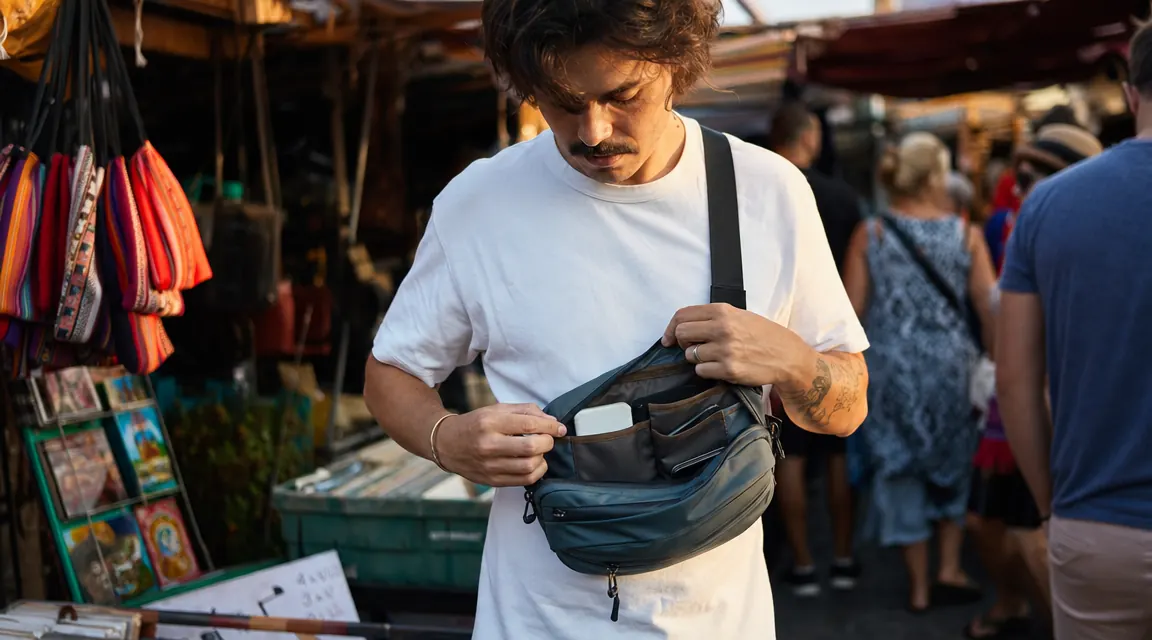
I bought mine before a two-week trip to Morocco and Portugal in early 2025. Marrakech's medina is exactly the kind of environment where bag choice matters: narrow alleys, dense crowds, persistent attention from vendors, and a genuine history of opportunistic theft. I wanted something that would keep my cards and passport close without advertising that I was a tourist with valuables. I had heard about the WATERFLY from a friend who had used it in Tokyo. She is five feet two and travels in business class. Her use case and mine are not the same thing. That gap in perspective is exactly what this review is here to bridge.
The Quick Verdict
Better than its price has any right to be, but with two real limitations that the review aggregate buries: strap padding that underdelivers on full days, and no physical slash resistance. Know those two things going in and this is a genuinely excellent budget travel sling.
Amazon Check Today's Price →Traveling somewhere crowded and wondering if budget pricing buys real security?
The WATERFLY sling bag earns its rating for most travelers, but not for every traveler. Check the current price on Amazon and read through the one- and two-star reviews alongside the five-stars for the full picture.
Amazon Check Today's Price on Amazon →What I Actually Tested and How
My testing covered three distinct environments. First, Marrakech and Fes in Morocco: two weeks of medina navigation, day trips to the Atlas foothills, crowded souks, and overnight train travel. Second, a five-day trip to Prague during the Christmas markets in December, which meant cold weather, heavy crowds at the markets, and a lot of public transit. Third, an eight-hour Tokyo transit day in March, navigating Narita to Shinjuku to Shibuya and back, using nothing but this bag and a personal item packing cube. Between those three contexts, the bag covered hot and humid conditions, cold conditions, and the kind of organized chaos that reveals whether urban transit credentials are real.
My testing focus was different from a standard durability review. I was specifically watching for the gap between what the listing claims and what the bag delivers in practice. That means: does the RFID pocket actually function as a pocket or is it theater? Does the lockable zipper work under real conditions or just demo conditions? Does the crossbody format actually reduce theft risk or does it just feel like it does? And perhaps most importantly: who is this bag actually built for and who is buying it under false assumptions?
The RFID Claim: Partially True, Which Matters
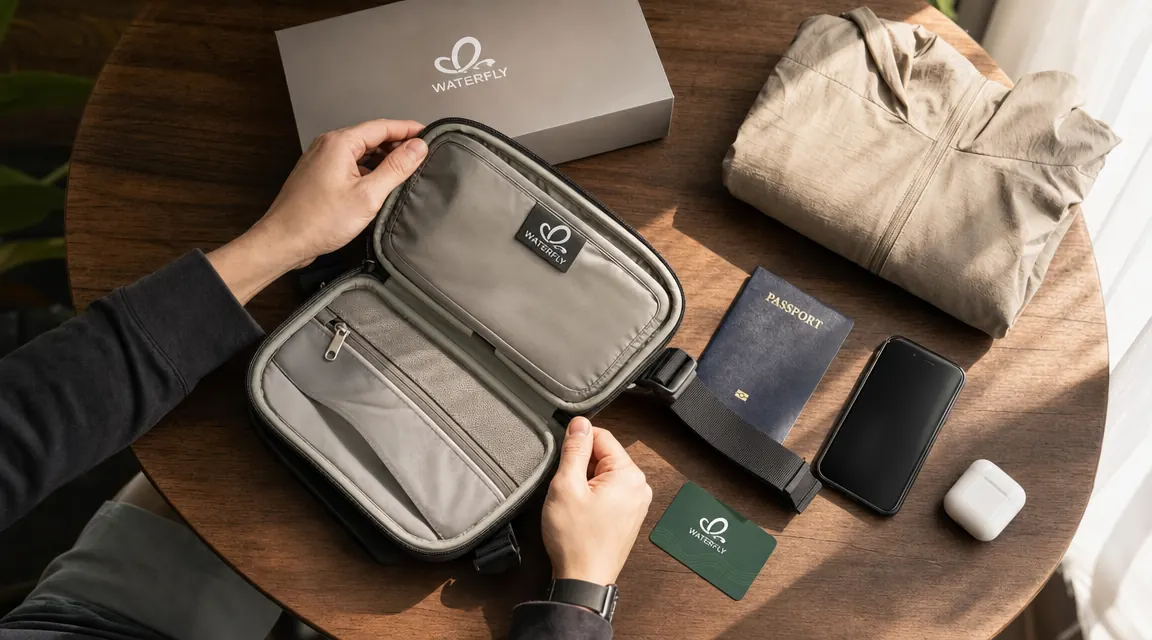
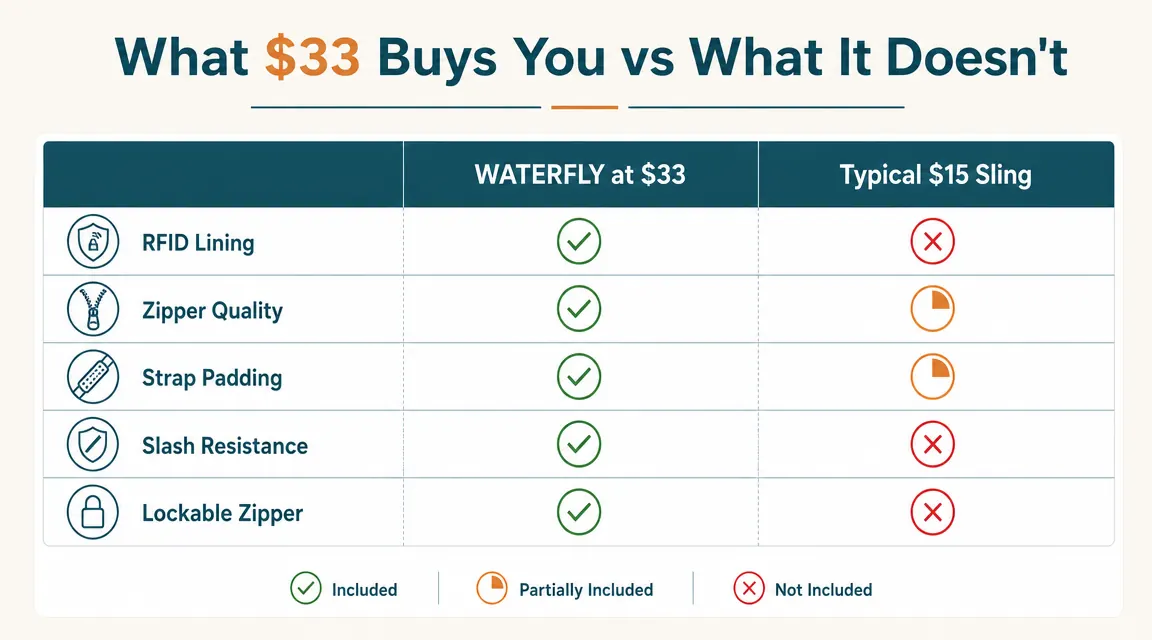
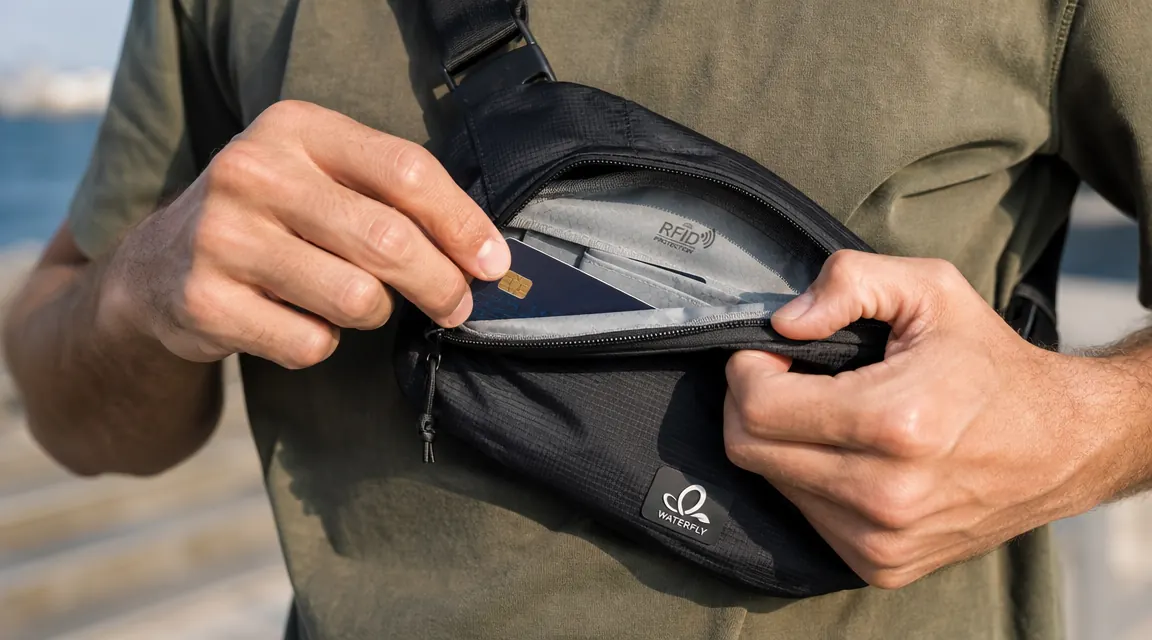
The listing says RFID-blocking and it is not lying, but it is also not telling the whole story. The RFID lining lives in one specific pocket: the inner zip compartment at the front of the bag. That compartment fits roughly four cards laid flat, maybe five if they are slim. Everything else in the bag, the main compartment, the middle section, the side pocket, none of it is RFID-lined. This is standard practice for bags at this price point, but the product photos and the headline claim can mislead a buyer into thinking the entire bag is shielded.
In practice, this means your strategy matters. If you put your contactless cards in the RFID pocket and leave them there, you get genuine protection. If you leave a card in the main compartment because the RFID pocket is full of receipts and lip balm, you are not protected. I kept two bank cards and my transit card in the RFID pocket for the full two weeks in Morocco and the lining performed correctly every time I tested it with a reader app. But I watched two other travelers in Marrakech pull their cards out of main compartments and wave them around at a payment terminal, genuinely believing their entire bag was shielded. It is not. Pocket discipline is part of the deal.
What the One-Star Reviews Are Actually About
When a product has tens of thousands of reviews, the one-star minority tells you more than the five-star majority. The WATERFLY's negative reviews cluster around three complaints. First: the strap digs in on longer wear. Second: the zipper pull broke. Third: the bag is smaller than expected. The first complaint is legitimate and I will address it. The second is a real quality control issue that appears to affect a small percentage of units, probably under three percent based on the review volume, but it is worth knowing. The third complaint is almost always a failure to read the dimensions before purchasing.
The dimensions on the Amazon listing are accurate: roughly 16 inches tall, 9 inches wide, 4 inches deep when full. That is a compact bag. If you are picturing something closer to a hydration pack or a school-day backpack, you will be disappointed. If you are picturing a slightly larger version of a belt bag with organization, you will be pleased. The disappointment in a lot of those reviews comes from a use case the bag was never designed for: carrying a laptop, a full-size water bottle, a camera with extra lenses, a change of clothes, and snacks. That is a different product category entirely.
The one-star reviews on a well-rated product tell you more than the five-star majority ever will. Read them first, not last.
Strap Comfort: The Honest Assessment
The strap situation is the most important thing to understand before buying, and the review aggregate buries it because most buyers do not wear the bag long enough in one stretch to notice. The strap is sturdy nylon with a slim shoulder pad. For trips under four hours in mild temperatures, it is completely adequate. For a full eight-hour transit day in Tokyo, carrying around six pounds of gear in warm station air, I felt the strap pressure on my left shoulder by hour five. Not pain, but noticeable fatigue. For Prague in December wearing a coat, the padding issue mostly disappeared because the coat shoulder provided additional cushion. Context changes the experience significantly.
The adjustable length is one of the bag's genuine strengths. The range is wide enough that I could configure it for a high crossbody carry in the Marrakech medina, then drop it to a lower hip position when I was on the train and wanted to rest my shoulder. The adjustment mechanism is smooth and, critically, it holds its setting. I have used bags where the strap slowly loosens throughout the day and sends the bag drifting down. The WATERFLY does not do that. The slider locks and stays locked.
If you are planning extended all-day wear in heat, an inexpensive neoprene shoulder pad add-on from any sporting goods store or Amazon fixes the strap limitation cleanly. I consider that a fair trade at the price point, but I want you to know about it before you arrive at a market in Fes at 9am planning to walk until 5pm.
What Nobody Mentions About the Organization Layout
The pocket layout is genuinely cleverer than the photos suggest. Most sling bag reviewers describe the number of pockets and move on. Here is what the layout actually enables if you set it up intentionally. I kept my phone in the top-access external pocket on the main compartment, reachable without unslinging the bag or unzipping anything. My passport went in the back panel slip pocket, the one that sits against my spine when wearing crossbody, which is the most physically secure position on the bag. Cards and transit card stayed in the RFID inner zip. That left the main compartment for a folded packable jacket, a collapsible 500ml bottle, earbuds case, and a small first aid kit.
The key clip inside the main compartment is small but genuinely useful. In Morocco, I clipped my riad key there rather than putting it loose in a compartment where it scratched against my camera. In Tokyo, I used it for a small luggage lock. It sounds like a minor detail until your key is gone at midnight in an unfamiliar city.
One layout limitation I did not expect: the side bottle pocket is designed for slender water bottles. A standard 500ml Nalgene or a wide-mouth Hydro Flask bottle will not fit. A collapsible bottle or a standard grocery-store water bottle fits fine. If you have a specific bottle habit, check the pocket dimensions against your bottle before you commit. The WATERFLY product listing notes it fits most bottles, which is technically true but worth verifying for wider formats.
Anti-Theft: What Works and What Is Marketing
Crossbody positioning is the primary anti-theft feature and it is real. A bag worn at your chest is in your field of vision constantly. You feel movement against it. You can place a hand on it without it looking paranoid. In Marrakech's Jemaa el-Fna square at peak tourist hours, I felt genuinely relaxed about my bag in a way I would not have with a backpack. That comfort is worth something. The lockable main zipper takes a standard small TSA lock and is a secondary layer that matters most at airports when your bag goes through the tray on its own.
What is marketing: the phrase anti-theft as applied to the fabric itself. The WATERFLY's outer shell is textured nylon, which is not slash-resistant. If someone wanted to cut the strap or slice the bottom of the bag, the fabric would not stop them. WATERFLY does not explicitly claim the fabric is slash-proof in its listing, which I respect, but some reseller descriptions do, and buyers reading quickly may not catch the distinction. For environments with a documented history of strap-cutting or blade theft, this bag is not the right answer. For the vast majority of tourist destinations, the crossbody format plus RFID pocket is more than sufficient.
Build Quality at the Mid-Range Price Point
The zipper quality is the most positive surprise. Both zippers on my bag, the main compartment and the RFID pocket, have performed without a single snag or skip across the full Morocco, Prague, and Tokyo testing period. The pulls are metal with a rubberized grip that has not cracked or peeled. Budget bags often have plastic pulls that fatigue and break within a few months. The WATERFLY's zipper quality lands closer to bags priced twice as high, and for a product that lives and dies on its ability to open and close reliably hundreds of times in a trip, that matters more than almost any other single spec.
The fabric holds its structure when loaded and recovers its shape when emptied. After the full Morocco trip, some scuffs on the bottom corners are visible on close inspection, a result of the bag hitting stone floors in airport lounges and medina guesthouses. The exterior shell is not scratch-proof, but the scuffs are surface level and did not penetrate to the interior lining. The back panel that sits against your body is padded with a mesh panel that helps airflow on warmer days, which I noticed in Morocco and appreciated. The construction feels intentional rather than assembled to a budget without thought.
What I Liked
- Zipper quality is genuinely above expectations for the price bracket, no snags across extended testing
- RFID pocket functions correctly and the lining has not degraded with repeated use
- Crossbody format provides real, passive theft deterrence in crowded urban environments
- Pocket layout rewards intentional setup and accommodates a full day-trip load efficiently
- Strap adjustment range is wide and the slider holds its position without creep
- Lockable main zipper accepts a small TSA lock cleanly with no adapter required
- Back panel mesh provides meaningful airflow in warm-weather conditions
Where It Falls Short
- Strap shoulder pad is too thin for full all-day wear in warm climates without a pad add-on
- RFID lining covers only one specific inner pocket, not the entire bag, which surprises some buyers
- Outer fabric is not slash-resistant despite some reseller listings implying otherwise
- Side bottle pocket is sized for slender bottles only; wide-mouth bottles will not fit
- A small percentage of units have reported zipper pull failures, suggesting some quality control variance

Who This Is For
The WATERFLY sling bag is the right choice for travelers who want meaningful RFID protection and a compact day-carry format without spending Pacsafe or Tom Bihn money. It is ideal if your destinations are medium-risk urban environments, think European cities, Southeast Asian capitals, and popular Latin American tourist towns, where crossbody positioning and RFID card shielding cover the realistic threat profile. It works for transit-heavy days where you need one bag that moves with you through metros, airports, and street markets without being in the way. It is also a strong fit for travelers who are petite to average frame and do not need to carry heavy loads. The bag's form factor fits compact bodies particularly well.
Who Should Skip It
Skip it if you are heading to destinations with documented blade theft or slash-and-run bag snatching, where physical fabric security is the first requirement rather than RFID. Skip it if you need to carry more than seven pounds of gear regularly, whether that means a laptop, camera equipment, or a full day's worth of supplies for a long hike. Skip it if you plan to wear one bag all day in heat and have no interest in adding a shoulder pad. And skip it if you are expecting the entire bag to function as an RFID shield rather than one dedicated inner pocket. None of those limitations make it a bad bag. They make it the wrong bag for specific situations. If your situation is different, read the WATERFLY versus Pacsafe Metrosafe comparison or the full guide to avoiding pickpockets with an RFID sling bag for a more targeted fit.
If the honest version still sounds right for your trip, it probably is
The WATERFLY sling bag earns its 4.5 stars for the travelers it is designed for. Check the current price on Amazon and see whether the available colors and sizes match what you need before your next departure.
Amazon Check Today's Price on Amazon →