

I bought the WATERFLY RFID crossbody sling bag in September 2024, right before a four-week trip through Portugal and Spain. My rule for day bags in tourist-heavy cities is strict: if I cannot see and touch the zipper at all times, I do not trust it. I had been using a cheap canvas bag from a market stall and lost a transit card in Madrid. That was enough. I wanted something with RFID blocking, a front-facing compartment I could access without taking it off, and a build that could handle nine months of carry across six countries. The WATERFLY cost $32.99 on Amazon. I was skeptical, but 47,000 ratings suggested I was not the first person in this situation.
Nine months later, I have worn this bag through Portugal, Spain, Thailand, Vietnam, Colombia, and Peru. It has been on overnight buses, through airport security more times than I can count, into jungle heat and coastal humidity, and across city metros where my hand was on the zipper the whole time. Here is the full picture.
The Quick Verdict
A genuinely capable travel sling at an honest price. The RFID protection works, the organization is thoughtful, and the build quality is better than $33 usually delivers. The strap comfort softens after break-in but the narrow profile means it is not built for loads over 8 lbs.
Amazon Check Today's Price →Still carrying a bag that makes you nervous in crowded places?
The WATERFLY sling bags RFID lining, lockable zipper, and front-access pocket are designed for exactly the situations where regular bags fail you. Check the current price on Amazon before your next trip.
Amazon Check Today's Price on Amazon →How I've Used It
My standard setup: passport in the back slip pocket (closest to the body), two bank cards and a transit card in the RFID-lined front pocket, phone in the side slot, and a collapsible water bottle in the main compartment alongside my small camera and a packable rain shell. That combination sits around six to seven pounds, which is comfortably within what the bag handles well. I wore it crossbody with the bag positioned at my chest in high-density crowds and rotated it to my hip when things opened up.
On long transit days, specifically the eleven-hour overnight bus from Medellin to Cartagena, I used it as my personal item at my feet since the overhead bins were stuffed. It held its shape. The main zipper did not catch or snag once. On several days in Bangkok, I wore it for eight-plus hours straight in 95-degree heat. That is where I first noticed the strap padding, which I will cover in the comfort section.
By month three I had stopped thinking about the bag as a conscious choice and started just grabbing it. That is the real test of travel gear: when it disappears into the routine. The WATERFLY passed that test by month four and has not failed it since.
RFID Protection: Does It Actually Work?
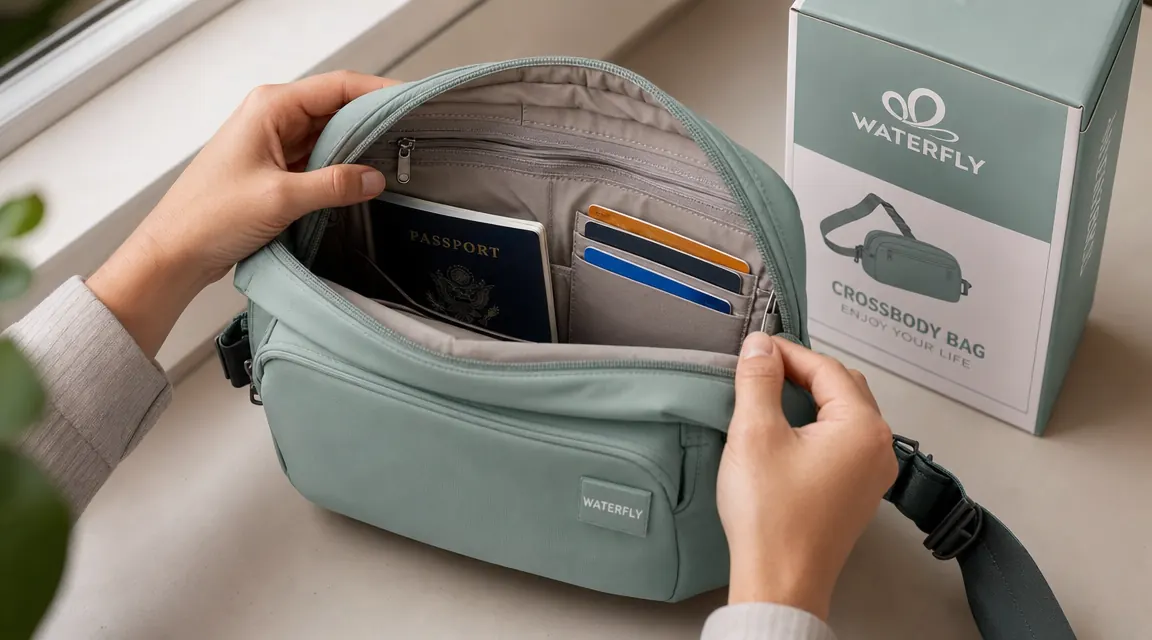
RFID skimming is less common than travel blogs make it sound, but it is a real threat in specific environments: metro turnstiles in crowded cities, certain outdoor markets, and busy transportation hubs. I carry a Visa debit card and an AMEX that both use contactless technology. Before committing to the WATERFLY I tested the RFID pocket with a cheap card reader I borrowed from a friend who works in IT security. Cards inside the dedicated RFID pocket: no read. Cards in the main compartment: readable. That distinction matters and WATERFLY is clear about it in the product listing, which I appreciate.
After nine months of daily use, I retested the RFID pocket. Same result. The lining has not degraded or delaminated. I keep three cards in there routinely. One thing worth knowing: the RFID pocket is the inner zip compartment at the very front of the bag. It is not the larger main compartment. If you stuff it with non-card items, you lose the protection for those cards. Use it for cards and cards only and it does its job without drama.
Capacity and Organization: More Thoughtful Than the Price Suggests
The WATERFLY is not a large bag. Measured flat it runs about 16 inches tall, nine inches wide, and four inches deep, which puts it solidly in the compact daypack category. That is intentional. The whole point of a travel sling bag is that it rides close to the body and stays nimble in crowds. If you want to carry a laptop, a DSLR, and a change of clothes, this is the wrong bag. But for a full travel day where you need passport, phone, cards, a light layer, a water bottle, and a snack, it is well proportioned.
The internal layout has three main zones. The front zip pocket holds cards and small flat items. The middle section, about two to three inches deep, works well for a folded rain jacket, a portable charger, or a paperback. The main rear compartment takes the largest items: a one-liter bottle, a compact camera, a sandwich, and still has breathing room. There is also a top-facing key clip inside the main compartment, which I used for a mini carabiner carrying my apartment keys in Lisbon so they were always findable without digging.
By month four I had stopped thinking about the bag as a choice. I just grabbed it. That is the real test of travel gear: when it disappears into the routine.
The external side bottle pocket is snug enough that a standard half-liter bottle does not bounce or fall out during movement, which is more than I can say for several sling bags in the same price range. I ran with this bag twice, once chasing a departing ferry in Palawan, and the bottle stayed put both times.
Comfort and Strap: The One Honest Limitation
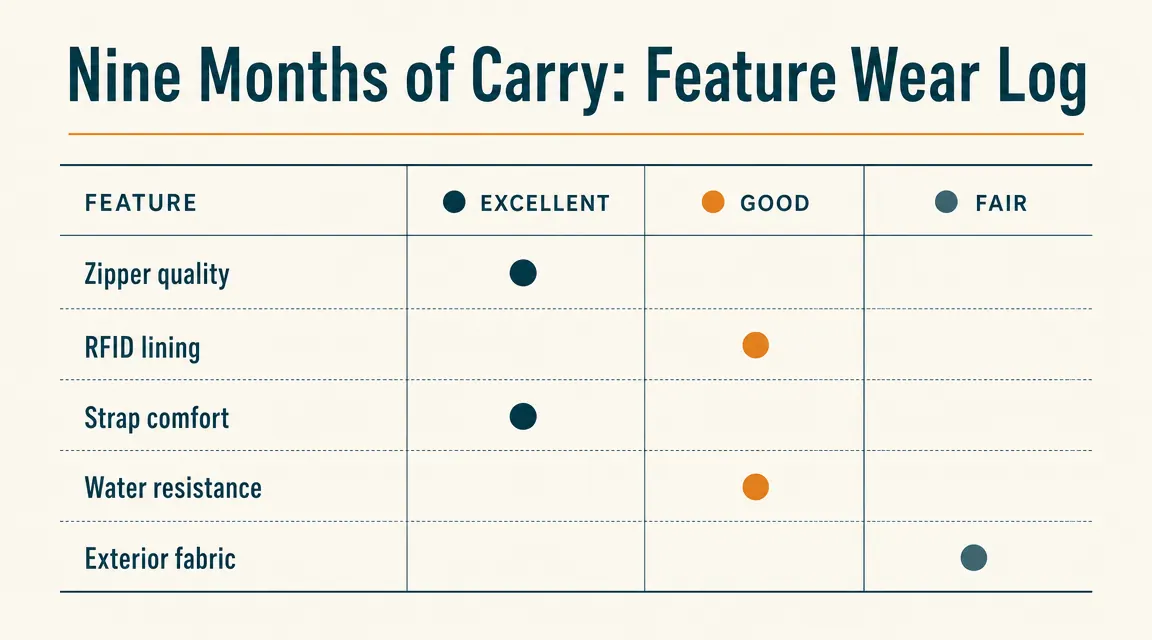
Here is where I have to be straight with you. The strap on the WATERFLY is the weakest part of the package. Not because it is flimsy, the strap itself is sturdy nylon with a solid buckle, but because the shoulder padding is thin. For trips under three hours this is not an issue. For a full eight-hour day of movement in heat, you feel it by hour five. The padded back panel helps reduce pressure against the body, but the strap padding could stand to be twice as thick.
I solved this in month two by adding a generic non-slip shoulder pad from Amazon for under $8. Problem gone. But I should not have had to solve it. If you plan to wear this bag all day in warm climates, budget for that small add-on or size up to a bag with a wider padded strap. This is the primary reason I did not score it higher.
The adjustable length range is generous, going from roughly 20 inches to 54 inches total strap length, which covers petite wearers to large-frame wearers comfortably. The adjustment slider works smoothly and does not slip once set. In nine months the slider has not crept or loosened on its own, which is not something I can say about two more expensive bags I tried before this one.
Anti-Theft Features: Real, Not Theater
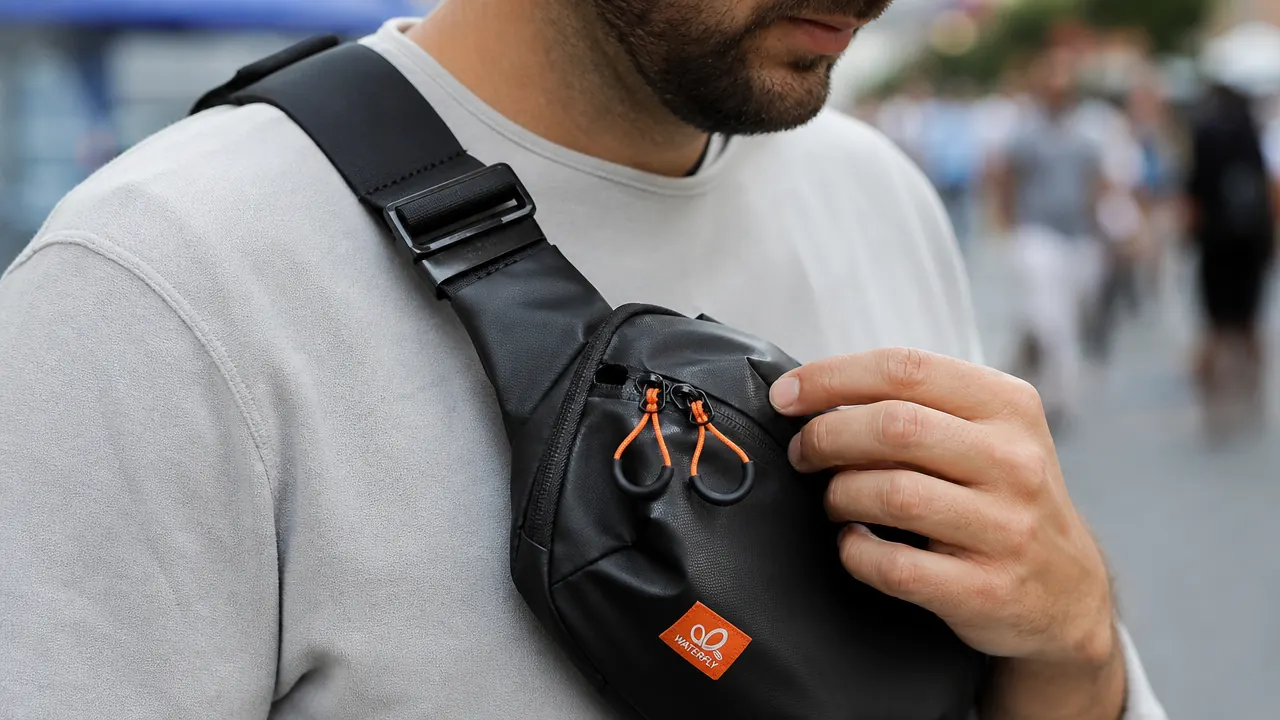
Travel bags often list anti-theft features that amount to marketing. Hidden pockets that are not actually hidden. Slash-proof fabric that is just regular fabric with a label. The WATERFLY's approach is more honest and more practical. The anti-theft features are three: the RFID-lined pocket I already covered, the lockable main zipper that accepts a small TSA-approved lock, and the crossbody wearing position itself.
That last one sounds obvious, but it is the most effective. A bag worn across the chest and within your field of vision at all times is dramatically harder to access than a backpack. In Hanoi's Old Quarter, one of the busiest street-market environments I have been in, I never once felt my bag was at risk. Not because of any sophisticated security feature, but because the format itself forces the bag to stay in front of you. The lockable zipper is a secondary layer I used at airports when the bag went through X-ray. I used a small numeric TSA lock on the main compartment. It fit without any friction.
The fabric is not slash-proof, and WATERFLY does not claim it is. If someone with scissors wanted to cut the strap, they could. That would be true of any bag in this price range and most bags above it unless you are spending Pacsafe money. See my comparison of WATERFLY versus Pacsafe Metrosafe if that level of protection matters to your destinations.
Durability After Nine Months: Where It Stands
The exterior fabric is a textured nylon that has held up well. No fraying at the seams, no pulling at the zipper tape, no structural deformation from packing and unpacking daily. The color, I chose a dark navy version, has faded very slightly at the strap adjustment area where metal contacts fabric, but you would only notice if you were looking for it.
The zippers are the standout durability story. Both the main compartment zipper and the front pocket zipper have been opened and closed at minimum twice a day for nine months. That is over 500 cycles each. Neither zipper has snagged, skipped a tooth, or required force. The pulls are metal with a rubberized grip that has not cracked. This is where budget bags often fail by month six, and the WATERFLY has not given me any reason to worry.
The buckle on the strap connector, where the strap attaches to the bag body, shows no stress cracking or loosening. I did notice the back panel padding compress slightly over time, which affects that all-day cushioning I mentioned. It is not a failure, just normal compression of foam over heavy use. If you rotate between two bags it would likely never be noticeable.
What I Liked
- RFID pocket works as described and has not degraded after nine months of daily use
- Zipper quality is genuinely above average for the price point, no snags in 500-plus cycles
- Front-access compartment layout is well thought out for real travel workflows
- Crossbody format keeps the bag in sight in high-density crowds without thinking about it
- Lockable main zipper accepts TSA lock with no adapter needed
- Side bottle pocket holds a half-liter securely even during light jogging
- Strap length adjustment range accommodates a wide variety of body sizes
Where It Falls Short
- Strap padding is thin for all-day wear in hot climates; a slip-on pad fixes it but adds cost
- Not slash-proof, which matters if you are traveling in high-theft regions
- Capacity tops out at around 7-8 lbs comfortably; not a substitute for a daypack
- Back panel foam compresses noticeably over several months of heavy daily use
- Only one external access point for quick item retrieval in the main compartment

Who This Is For
The WATERFLY sling bag is the right choice if you are a carry-on-only traveler who needs a compact day bag that keeps your cards, passport, and phone secure without looking like a tourist walking around with a padlocked vault on your chest. It is ideal for city travel in Europe, Southeast Asia, and Latin America, particularly for metro systems and street markets where a backpack would invite attention and a belt bag would be too small. It also works well as an airport personal item if you pack light, fitting cleanly under the seat in front when loaded with a day's essentials. At $32.99, it is honest gear priced at an honest number.
Who Should Skip It
If you are traveling to destinations with organized, aggressive theft and need full physical security including slash-resistant straps and slash-proof fabric panels, look at the Pacsafe Metrosafe instead. You will pay three times the price and it is worth it for specific situations. If you need to carry a laptop or tablet alongside your daily gear, the WATERFLY is too shallow. And if you plan to wear any bag all day in high heat without a strap pad add-on, the thin shoulder padding will bother you by afternoon. Know the limitations going in and this bag will not disappoint you. Go in without knowing them and you might blame the bag for a problem you could have solved for $8.
Nine months and six countries later, I would buy it again
The WATERFLY RFID sling bag is one of the most cost-effective pieces of travel gear I have tested. Check today's price on Amazon and read the current reviews from travelers in similar destinations.
Amazon Check Today's Price on Amazon →