
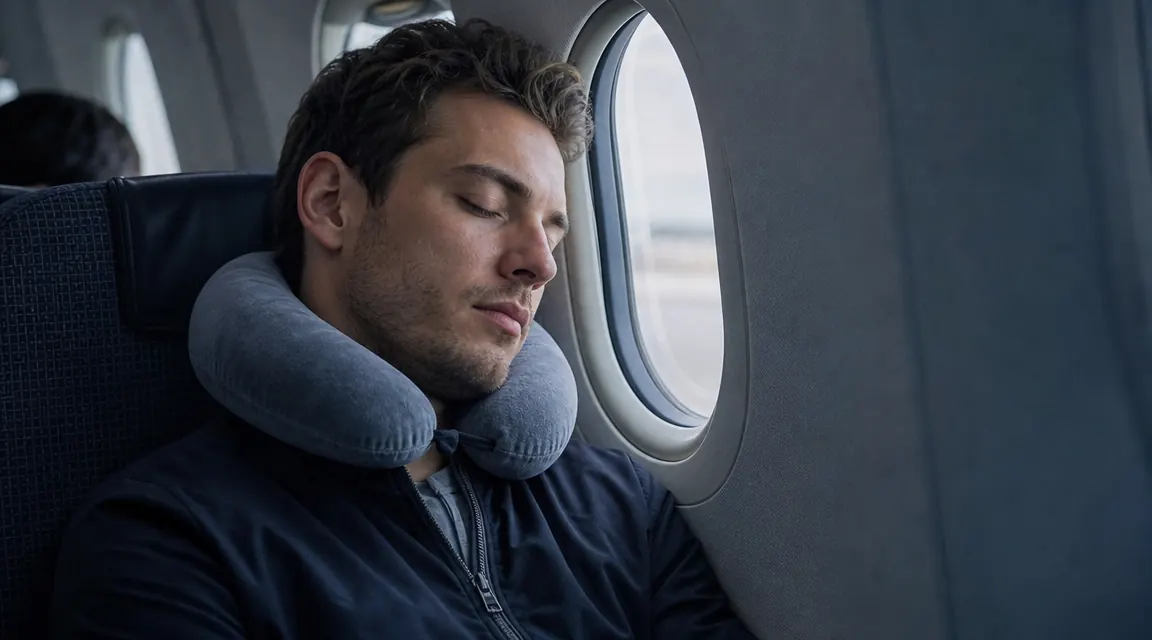
I fly economy. I always have. And for the first four or five years of carry-on-only travel, I arrived at every destination with a stiff neck, gritty eyes, and the kind of fatigue that eats half your first day. I tried everything the internet recommended: folding a hoodie against the window, using the pillow the airline hands you, reclining to the exact angle that made the passenger behind me visibly annoyed. Nothing worked. Then I figured out that almost all of the standard advice skips the part that actually matters.
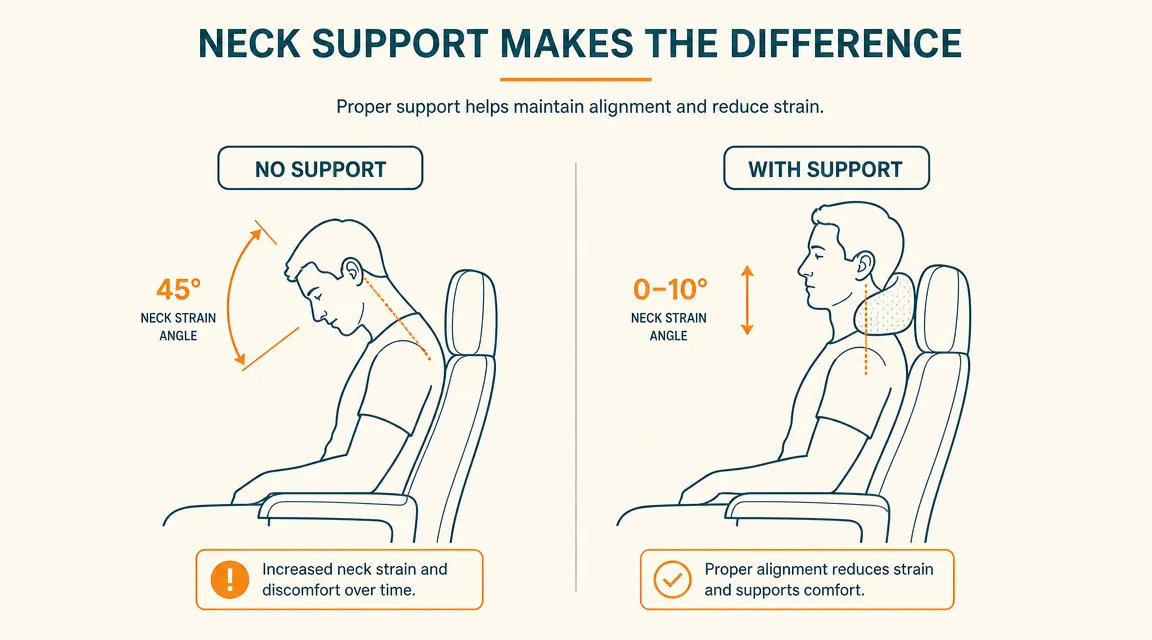
Your neck is the problem. When you fall asleep sitting upright, your head weighs roughly ten to twelve pounds. Without something holding that weight in a neutral position, your chin drops to your chest, the muscles along the back of your neck activate to catch it, and you wake up rigid thirty minutes later. Every other sleep trick, the eye mask, the melatonin, the right seat row, means nothing if your neck falls forward the moment you drift off. Fix the neck first, and everything else starts to work. The Cabeau Evolution S3 neck pillow is the tool that fixed it for me, and this guide is built around using it correctly.
If your neck wakes you up every time you finally fall asleep on a flight, this is the fix.
The Cabeau Evolution S3 is a memory foam neck pillow with seat strap clips that anchor it to the headrest and keep your head from falling forward. It's what I bring on every flight now, including the red-eyes. Check the current price and size options on Amazon before you book your next trip.
Amazon Check Today's Price on Amazon →Step 1: Choose the Right Neck Pillow Before You Ever Board
Not all neck pillows are the same, and the differences matter more than most gear reviews let on. The U-shaped inflatable pillows you see at every airport gift shop solve one problem: they're cheap and compress to nothing. What they don't do is hold your head in a stable position. Inflatable pillows are soft enough that your head still droops, just more slowly. You end up in the same place, stiff neck, just an hour later.
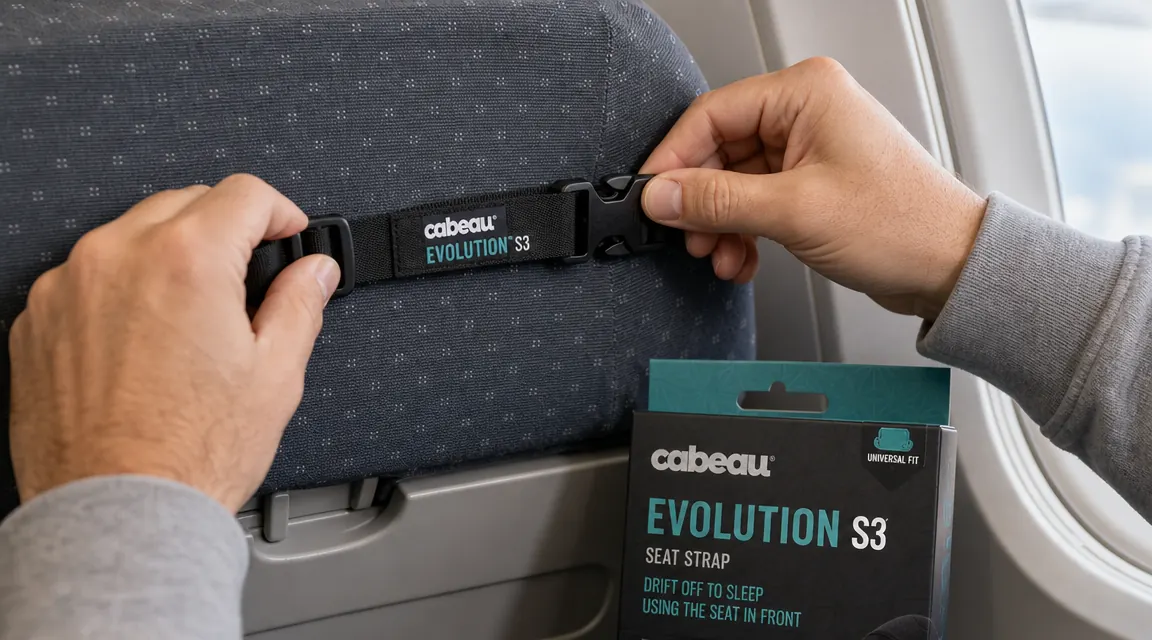
Memory foam neck pillows are different because they push back. The Cabeau Evolution S3 uses a flat-back design rather than the old horseshoe shape, which means it actually contacts the back of your neck where support matters. The foam is dense enough to hold your head without bottoming out, but not so rigid that it feels like resting on a rolled yoga mat. The version I've been using also has two small strap clips that loop around your seat's headrest wings and snap together, preventing the pillow from sliding sideways when you fall asleep leaning to one side. That detail alone changed how well the whole system works.
If you're weighing options, I've written a detailed breakdown in my full review of the Cabeau Evolution S3. The short version: it is worth the price over the alternatives I've tried, and the strap system is the deciding factor.
Step 2: Book the Right Seat for Sleeping
Seat selection has more impact on sleep quality than most people give it credit for. Window seats are almost always better for sleeping than middle or aisle seats for one simple reason: you have a wall to lean against. The airplane fuselage curves inward at shoulder height, which means a window seat gives you a secondary surface to brace against even before your neck pillow does its job. Aisle seats put you in the direct path of the drink cart, the restroom parade, and anyone who needs to get past you in the night.
Front-of-cabin economy rows are generally quieter. Avoid seats directly in front of the lavatory, where the door noise and odor become your problem every thirty minutes. On flights over six hours, the exit row seems appealing for legroom, but exit-row seats often don't recline at all, which makes sleeping harder, not easier. A standard row closer to the front of economy, on the window side, is usually the best trade-off.
One more thing on seating: if you can swing a red-eye departure time where most of the plane is also trying to sleep, the ambient noise level and cabin lighting drop significantly, making the entire sleep environment easier to manage.
Step 3: Set Up Your Neck Pillow Before Takeoff, Not After
This is where most people go wrong. They stow the neck pillow in the overhead bin, eat, watch a movie, and then try to set everything up at hour three when they're already tired and the cabin is dark. By then you're fumbling in the dark, bothering your seatmate, and your body is already in a poor position.
The better approach: pull the Cabeau out before you sit down, loop the strap clips around the headrest wings immediately, and snap them together. You don't have to wear the pillow during takeoff, but having it clipped and ready means you can lean into it the moment you're settled. The seat strap clips on the Evolution S3 thread through the gap between the headrest wings without requiring you to disassemble anything. It takes about fifteen seconds once you've done it twice.
Position matters too. The pillow works best sitting slightly higher than you might expect, with the flat back pressing against the base of your skull rather than mid-neck. You want your chin level, not tucked. If your head tilts back and your mouth falls open, the pillow is sitting too low. Slide it up an inch and re-clip.
Step 4: Layer in the Right Supporting Gear
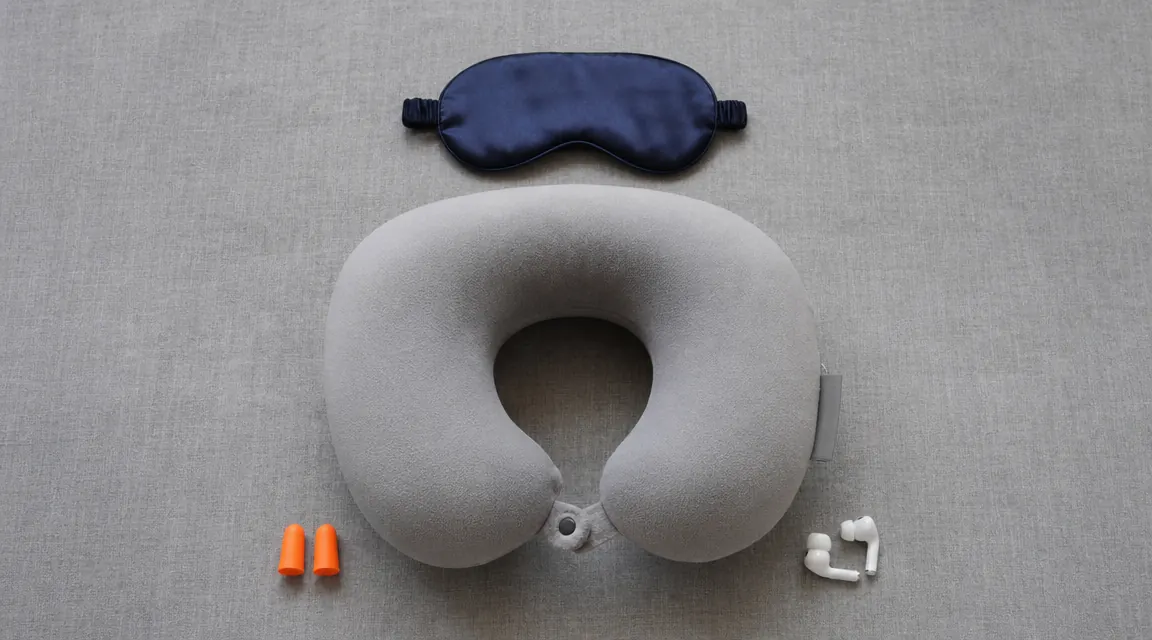
With your neck sorted, the rest of the sleep setup can do its job. The four items I bring on every flight are the neck pillow, a sleep mask, ear protection, and a pair of compression socks. Each one addresses a specific problem that the others can't fix.
Sleep masks matter because economy cabins are never fully dark. Even at 2 a.m., there are reading lights, screen glow from seatmates, and overhead indicators. A well-fitting mask that doesn't press on your eyelids makes a genuine difference in sleep quality. Ear protection blocks the constant low-frequency roar of the engines, which your brain keeps processing even when you feel asleep. I switch between foam earplugs and noise-canceling earbuds depending on how long the flight is. For anything over five hours, the earbuds win because they let me play a consistent low ambient sound underneath the active noise cancellation.
Compression socks feel like overkill until you're on a nine-hour flight and your ankles are swollen before you land. They keep blood circulating, reduce that specific kind of leg heaviness that makes it impossible to get comfortable, and cost almost nothing. These are not luxury items. They're functional gear that makes sleep more likely.
Step 5: Manage Your Body and Timing, Not Just Your Gear
The gear sets the stage, but your body needs a little cooperation. The two biggest mistakes I see are drinking alcohol to fall asleep and eating a heavy meal on the plane. Both feel like they should help, and both backfire. Alcohol disrupts sleep architecture, so you fall asleep faster but sleep lighter and wake earlier. A heavy meal sends blood to your digestive system when your body is trying to rest, creating a restless, half-asleep state that's more frustrating than just being awake.
For red-eye flights, I eat before I board, skip the in-flight meal service, and drink water instead of wine. I set my watch to the destination time zone the moment I sit down. If it's nighttime at the destination, I try to sleep. If it's daytime, I stay awake and use the flight to adjust rather than extend the wrong sleep window. This is low-tech, zero-cost jet lag management that works better than any supplement I've tried.
Limit screen time in the hour before you want to sleep. This applies on planes just as much as at home. The overhead entertainment screen at close range is more disruptive to sleep readiness than most people realize. Put on something audio-only, or nothing, and let your eyes rest. With your neck supported by the Cabeau, your ears blocked, and your eyes covered, your body gets a clear signal that sleep is the plan.
What Else Helps
A few things have made a meaningful difference beyond the core five-step setup. Wearing layers you can adjust matters: planes run cold at altitude and warm on the ground, and being too cold is a reliably effective way to stay awake. A lightweight packable down jacket doubles as a lap blanket. Staying hydrated before and during the flight reduces the headache that often comes with long hauls. And choosing an aisle seat on a flight where you know you'll need the restroom a lot is just pragmatic. None of this is revolutionary, but each one chips away at the reasons the body refuses to relax.
If you want more context on why I picked the Cabeau Evolution S3 over cheaper options and what I tested before landing on it, the full long-term review covers six months of flights and the specific reasons the strap system matters. I also have a piece on why memory foam consistently outperforms inflatable neck pillows for anyone still on the fence about whether the price difference is justified.
Fix the neck first, and every other sleep trick finally gets a chance to do its job. That's the insight that took me five years and more stiff-necked mornings than I care to count to fully accept.
Stop arriving at your destination already worn out from the flight.
The Cabeau Evolution S3 is the neck pillow that made this whole setup possible for me. Memory foam, flat-back design, and seat strap clips that keep it anchored to the headrest. It's currently available on Amazon in two sizes with multiple color options. Check today's price and see if it's right for your next trip.
Amazon Check Today's Price on Amazon →