
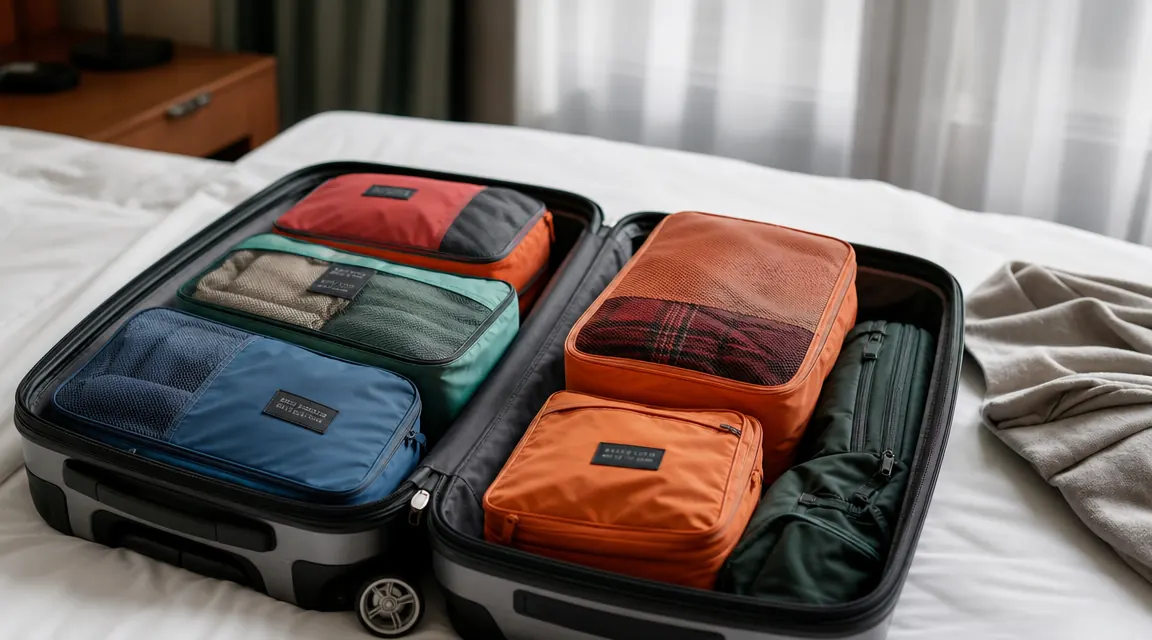
I used to check a bag on every trip longer than three days. Not because I had to, but because I had no system. I would stuff things in, run out of room halfway through, pull everything out, start over, and still show up at the airport with a bag that felt like a collapsed closet. The problem was never the suitcase. It was the absence of any structure inside it.
The fix turned out to be embarrassingly simple: packing cubes. Specifically, a good set of them paired with a repeatable five-step process that I now run on every trip, whether I am leaving for a long weekend or eight days abroad. I have used the BAGAIL 8-Set Packing Cubes for over a year of carry-on-only travel, and the method I am about to walk you through is exactly what I use before every flight. By the end of this guide, you will know which cube goes where, how to compress each one, and how to load the bag so nothing shifts and everything fits.
Stop rewashing clothes you already packed. Get the BAGAIL 8-Set and follow along.
The BAGAIL 8-Set comes with two large, two medium, two small, and two slim cubes, covering every clothing category from bulky sweaters to underwear. Over 42,000 Amazon buyers have made it the go-to packing cube set in this price range.
Amazon Check Today's Price on Amazon →Step 1: Lay Out Everything You Think You Need, Then Cut It by 20 Percent
Before a single cube gets opened, start on your bed. Pull out every item you are considering and line it up flat. Do this before you touch your bag. The visual reality of seeing everything in one place is what separates intentional packers from panic packers. You will almost always see at least two or three redundant items: that third pair of jeans, the backup shoes you never wear, the jacket you bring for emergencies that never qualify as emergencies.
For a seven-day trip, the formula I rely on is: seven pairs of underwear and socks (no negotiation), four tops that mix and match, two bottoms, one layer that doubles as a jacket or mid-layer, and one dress or nicer outfit if the trip calls for it. For five days, knock off one top and one bottom. This is the actual stuff that fits in a carry-on when it is organized. If your pile is significantly bigger than this, ask yourself which items can be hand-washed in a hotel sink overnight, because the answer is almost all of them.
The goal at this stage is not to pack. It is to commit. Once you know exactly what is going, you can assign every item to a specific cube category before you touch anything, and that mental map is what makes the later steps fast.

Step 2: Assign Each Clothing Category to the Right Cube Size
The BAGAIL 8-Set gives you eight cubes across four sizes: two large (L), two medium (M), two small (S), and two slim. Each size has a job, and once you internalize the assignment system, packing becomes nearly automatic. Here is the breakdown I use: large cubes hold shirts, t-shirts, and light sweaters. Medium cubes handle pants, shorts, and jeans (folded once lengthwise). Small cubes take socks and underwear. Slim cubes are for anything flat: scarves, belts, a swimsuit, a thin base layer.
The slim cubes are the sleeper hit of the set. Most people ignore them because they look too narrow to be useful, but they are exactly right for the flat items that otherwise float to the bottom of the bag and get lost. On my last trip to Lisbon, I used one slim cube for my swimsuit and beach cover-up and another for my belt and a lightweight scarf. Both cubes zipped flat, slid into the gap beside the large cube in my bag, and stayed there for eight days without me ever having to dig.
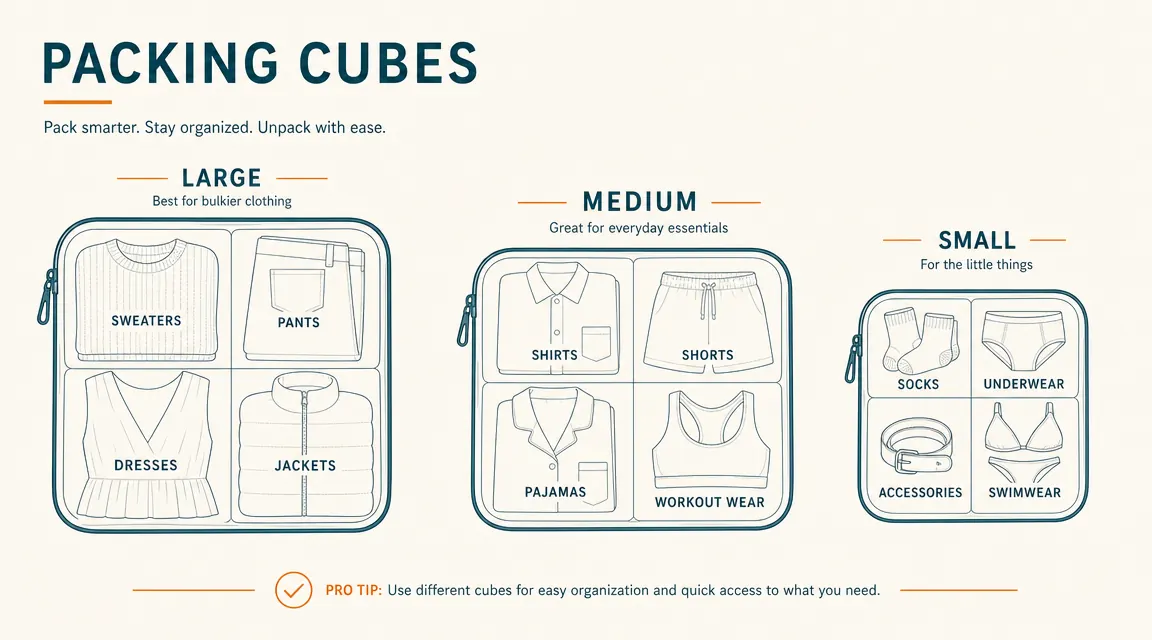
One assignment rule worth following: never mix categories in a single cube. The moment you put socks in with a shirt because you ran out of space, you have broken the system and created the same dig-to-find-it problem you are trying to solve. If a cube is genuinely full and you still have items left over, that is a signal to go back to Step 1 and cut more, not to compromise the category system.
Step 3: Fold and Load Each Cube Using the Bundle Method
Rolling clothes is popular advice, and it works. But for packing cubes, I have switched to a modified bundle fold that creates denser, wrinkle-resistant layers and uses the full interior of each cube more efficiently. The method: lay the item flat, fold in the sleeves or sides so the width matches the interior dimension of the cube, then fold the item in half lengthwise once. Stack identically folded items on top of each other before loading the cube. You end up with a flat, even stack that fills the cube without dead air pockets.
For the large BAGAIL cubes, I can fit five to six t-shirts stacked this way, or three to four long-sleeve shirts. The mesh top panel on each cube lets you see what is inside without opening it, which matters more than it sounds when you are navigating a hotel room at 6 a.m. For the medium cube with pants, fold each pair in thirds lengthwise first, then in half. Two pairs of pants plus a pair of shorts fits a medium BAGAIL cube with room to spare.
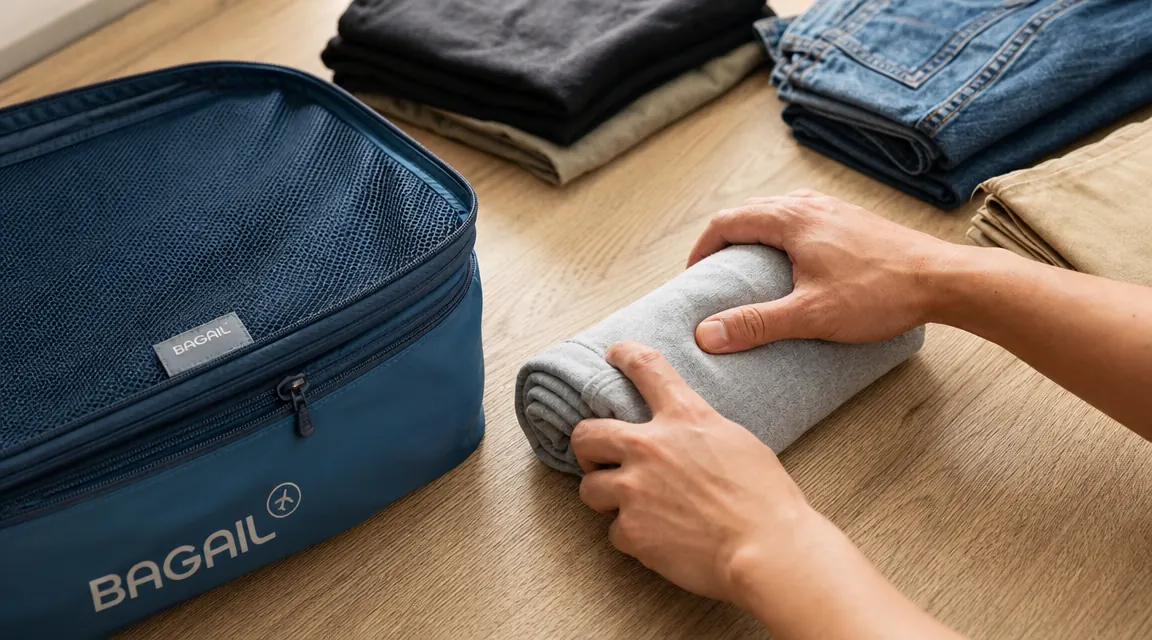
Compression is a separate conversation. The BAGAIL cubes are not compression cubes in the same sense as Eagle Creek Specter Compressions, which use a second zipper to squeeze the cube down. What BAGAIL gives you is a sturdy mesh face and a snug main zipper that holds the cube's shape under pressure. That is enough to eliminate the air that loose packing creates, and in practice I have found that tight, flat-folded loading does the compression work without needing a second zipper. If you are packing bulky sweaters or a fleece, use the large cube and load it last so you can lean on it as you zip.
Step 4: Load the Bag in the Right Order
How you stack the cubes inside the carry-on determines whether the bag zips cleanly and whether it stays organized through multiple unpacks and repacks. The loading order I use is: heaviest cubes go in first, flat against the back panel of the bag (the side that sits against your back when worn). Light cubes and slim cubes go on top or in the sides. Shoes, if any, go in the corners at the bottom, wrapped in a slim bag or shower cap.
For a standard 22x14x9-inch carry-on, which is the domestic limit for most US carriers, two large BAGAIL cubes sit side by side on the bottom layer. Two medium cubes go in the second layer. The four small and slim cubes fill in the remaining gaps and the front pocket or any secondary compartment. The result is a bag that is full but not strained, and every cube is retrievable without unpacking the others.
One habit that preserves this order through a multi-night trip: when you arrive at your hotel, pull the cubes out and stand them upright in a drawer or on a shelf, still organized. When you repack to leave, the cubes go back in the same loading order. The system travels with you rather than collapsing after the first night.
Step 5: Run a Final Overflow Check Before You Zip
This step takes ninety seconds and prevents the panicked repacking at the gate that every carry-on traveler has experienced at least once. Before you close the bag for the last time at home, do a walk-through of three zones: the main compartment, the front pocket, and any personal item or day bag you are carrying separately.
Main compartment: all cubes zipped, no loose items floating around. Loose items are the enemy of a repackable bag. They find their way to the bottom, they get forgotten, and they make the cubes harder to stack cleanly on the return trip. If something does not fit in a cube, decide right now whether it needs its own dedicated spot (shoes in a bag, electronics flat in the top) or whether it should go in the personal item instead.
Front pocket: this is where I keep anything that needs to be accessible without opening the main compartment: a slim battery pack, my travel-size toiletry set in its own bag, a collapsible tote for day trips, and a book or notebook. Keeping this zone consistent trip to trip means you never forget the power bank or have to rummage at security. The BAGAIL set does not include a toiletry cube, but I use one of the slim cubes doubled as a toiletry flat-pack when I am packing liquids in a quart bag.
What Else Helps
Packing cubes do the heavy lifting, but a few additional habits make the system more bulletproof. First, keep a permanent packing list on your phone. Not a from-scratch list you write before every trip, but a master list you refine over time. After each trip, note what you did not use and remove it from the list. After about five trips, the list stabilizes and packing becomes a twenty-minute checklist exercise rather than a forty-five-minute guessing game. Second, pre-stage your cubes. I keep the BAGAIL set permanently loaded with the base layer of clothes I take on almost every trip: a week of underwear and socks in the small cubes, workout clothes in one slim cube. When a trip comes up, I only need to top off the large and medium cubes with weather-appropriate tops and bottoms. The cubes sit in a drawer between trips, already partially packed, and the full pack takes under twenty minutes. Third, color-code if you travel with a partner. The BAGAIL 8-Set comes in multiple solid color options. When my partner and I travel together, we each have a different color set. No more opening a cube to find someone else's clothes. The bags stay separate at customs, at the hotel, at the laundry. It sounds minor until the first time you avoid a forty-five minute airport standoff over whose cube is whose.
The moment I stopped treating my carry-on like a container and started treating it like a filing cabinet, I stopped checking bags entirely. The cubes are not an accessory. They are the structure that makes the whole thing work.
If you want to go deeper on why packing cubes work and the specific durability differences between budget and premium options, I have a full long-term review linked below. The BAGAIL set specifically has held up through thirteen flights over fourteen months without a zipper failure or torn mesh panel, which in my experience puts it in a category most budget sets do not reach. The one honest limitation: the zippers feel lighter than Eagle Creek's, and if you are a packer who overstuffs to the edge of the cube every single time, you may see wear there after year two. For anyone packing within the cube's actual capacity, the zippers perform fine.
Ready to stop checking bags? The BAGAIL 8-Set is the starting point.
With two large, two medium, two small, and two slim cubes in one set, BAGAIL covers every category in this guide. Rated 4.6 stars across more than 42,000 Amazon reviews, it is the packing cube set I reach for every trip.
Amazon Check Today's Price on Amazon →