
Let me start with the thing Cabeau does not say on the product page: this is a real ask for a travel pillow, and the number of cheap horseshoe pillows that claim to do the same thing for much less does not make that ask any easier. I spent three flights trying to talk myself out of buying the Evolution S3 and using various budget alternatives instead. Those three flights ended with a stiff neck, a rolling inflatable that went flat, and a firm pledge to stop being cheap about gear I actually use. So I bought the Cabeau S3. This review is what I wish I had read before those three bad flights, not after.
The Cabeau Evolution S3 is rated 4.3 stars across close to 2,800 reviews on Amazon. That is a smaller review pool than some competitors, which means fewer people gaming the rating with incentivized reviews. I take a 4.3 on 2,800 honest reviews more seriously than a 4.7 on 50,000 suspicious ones. But a rating is not a review, and there are specific things about this pillow that the star distribution will not tell you. I am going to walk through them.
The Quick Verdict
The marketing is not lying, but it is selective. This is a genuinely good pillow with two real limitations that will matter more to some travelers than others. Know what you are buying before you spend the money.
Amazon Check Today's Price →Tired of waking up with a wrecked neck after every long flight? This is the fix most frequent flyers eventually land on.
The Cabeau Evolution S3 is available on Amazon in multiple colors. Check current pricing and read verified buyer reviews below.
Amazon Check Today's Price on Amazon →What Cabeau Gets Right (And Does Not Advertise Loudly Enough)
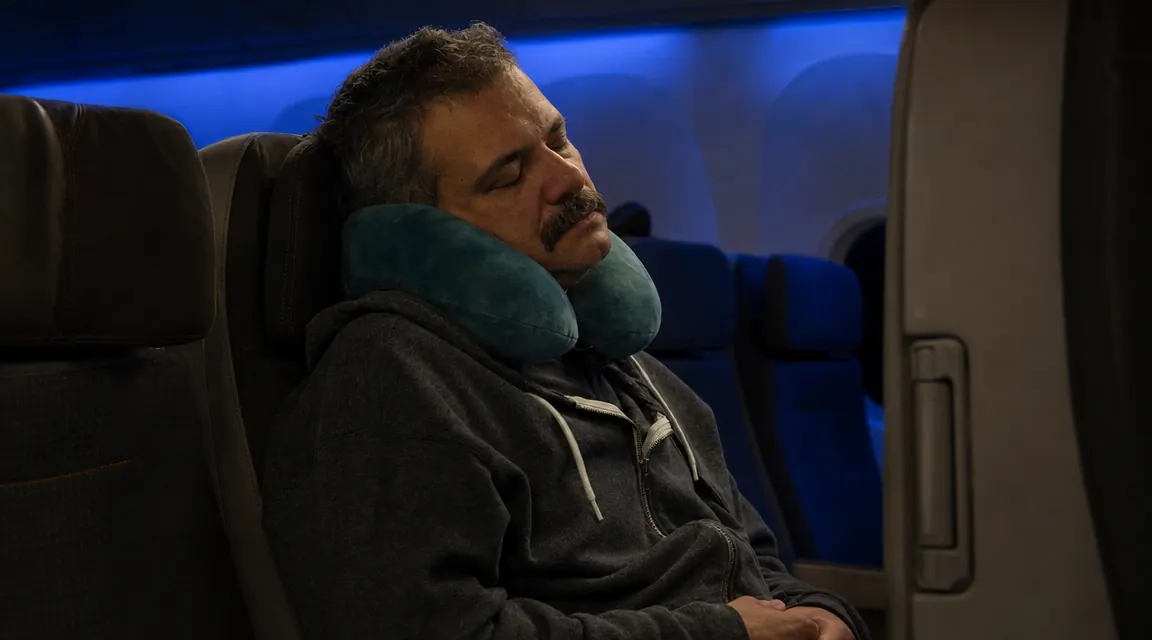
The core product works. Memory foam with real density, meaning the kind that pushes back rather than compresses to nothing, is what separates this pillow from the airport gift shop version. I tested this on a five-and-a-half-hour afternoon flight from Miami to San Francisco sitting in 22C, a middle seat with a broken recline button. The pillow held its shape from wheels-up to landing. I slept for about two hours in segments, and each time I readjusted, the foam re-formed in a few seconds rather than requiring me to pump anything up or reshape by hand. That sounds like a small thing. On hour four, it is not a small thing.
The raised front chin support is the feature Cabeau mentions but undersells in their copy. Most travel pillows are shaped like a horseshoe, which holds your neck from the sides but lets your chin drop toward your chest the moment you fall asleep sitting upright. The S3 has a raised front section specifically designed to prevent that. It is not perfect, because nothing is on a no-recline seat, but it reduced the head-drop problem by a meaningful amount on my Miami to San Francisco flight. The design works and it solves a real problem.
The washable cover is another feature that gets buried in the specs but matters in practice. I was on a Houston to Chicago flight when the person next to me spilled their orange juice and a small amount hit my bag and the pillow cover. I pulled the cover off in my hotel bathroom that night, hand-washed it in the sink, and it was dry and back on the pillow by morning. The foam itself zips away clean inside. That level of practicality matters when you are traveling carry-on-only and cannot just buy a replacement.
What the Brand Does Not Tell You: The Four Real Limitations
First limitation: heat. Memory foam holds body heat and the S3 is no exception. After about ninety minutes of contact, you will notice warmth at the back of your neck. On a cool overnight flight this is manageable or even welcome. On a daytime flight in a cabin that has not fully cooled from boarding, it becomes a distraction. Cabeau does not address this anywhere in their main product copy. Some competing pillows use ventilated foam specifically to address this. The S3 does not.
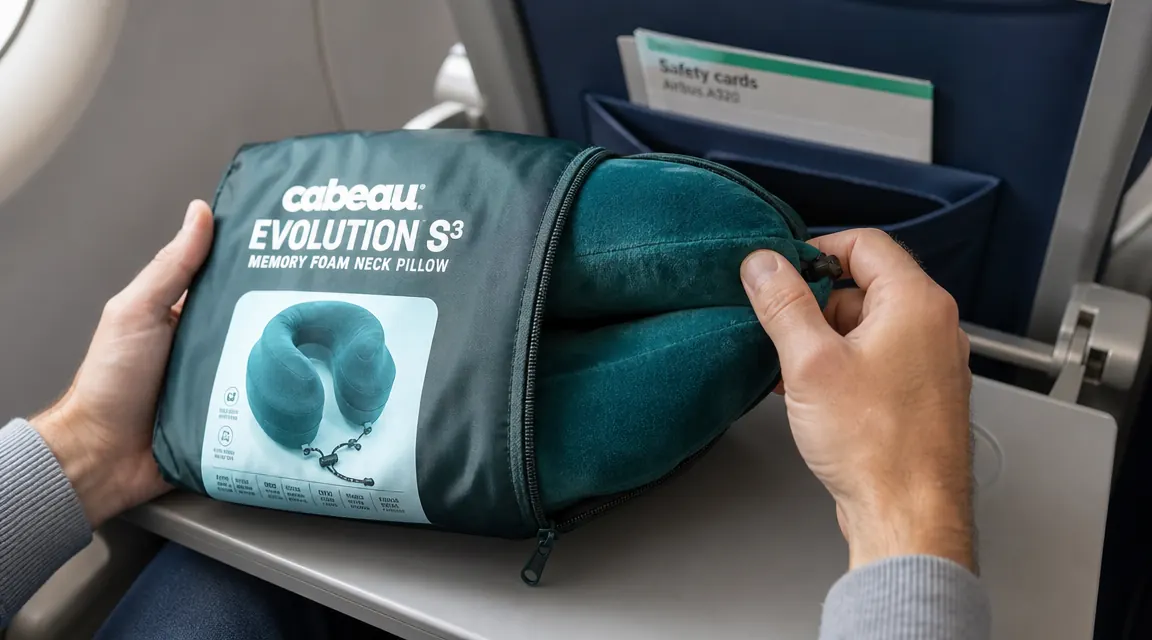
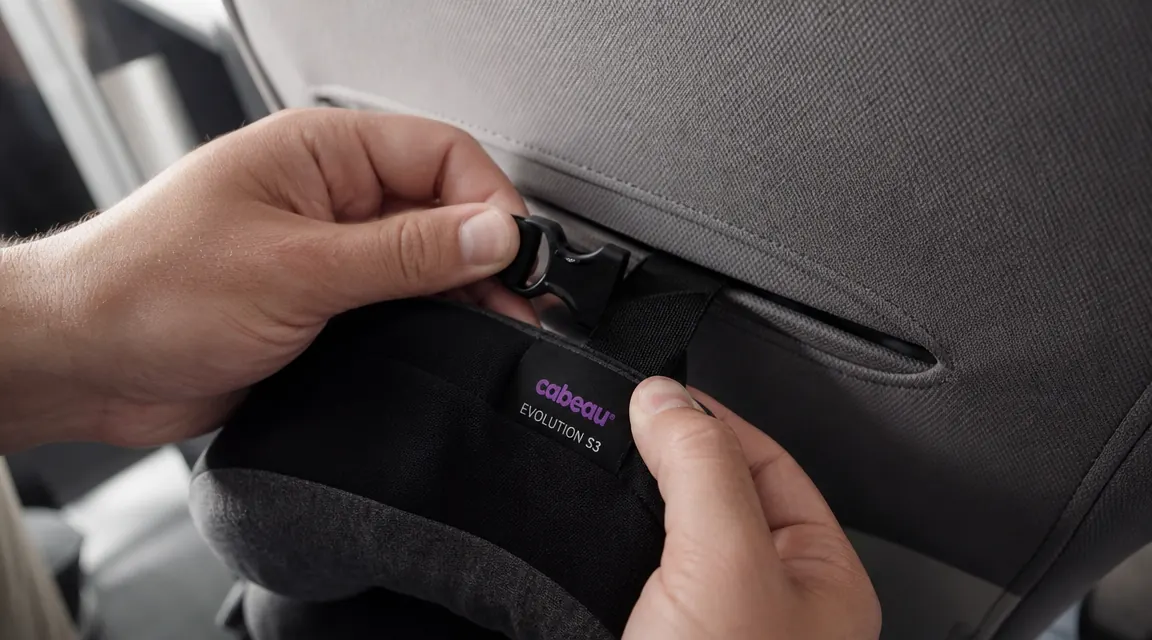
Second limitation: the seat strap clips work on most planes but not all. Cabeau markets the clips as a key differentiator, and they are useful when they work. The clips thread through the slots in the top of most standard airline headrests. On Delta, United, and American mainline jets, I have never had a problem. On Spirit and Frontier, several seats had headrests without slots or with slot spacing too narrow for the clip hardware. On those flights, the pillow functions like an unclipped horseshoe. It still works; it just does not stay anchored the way the marketing implies it always will.
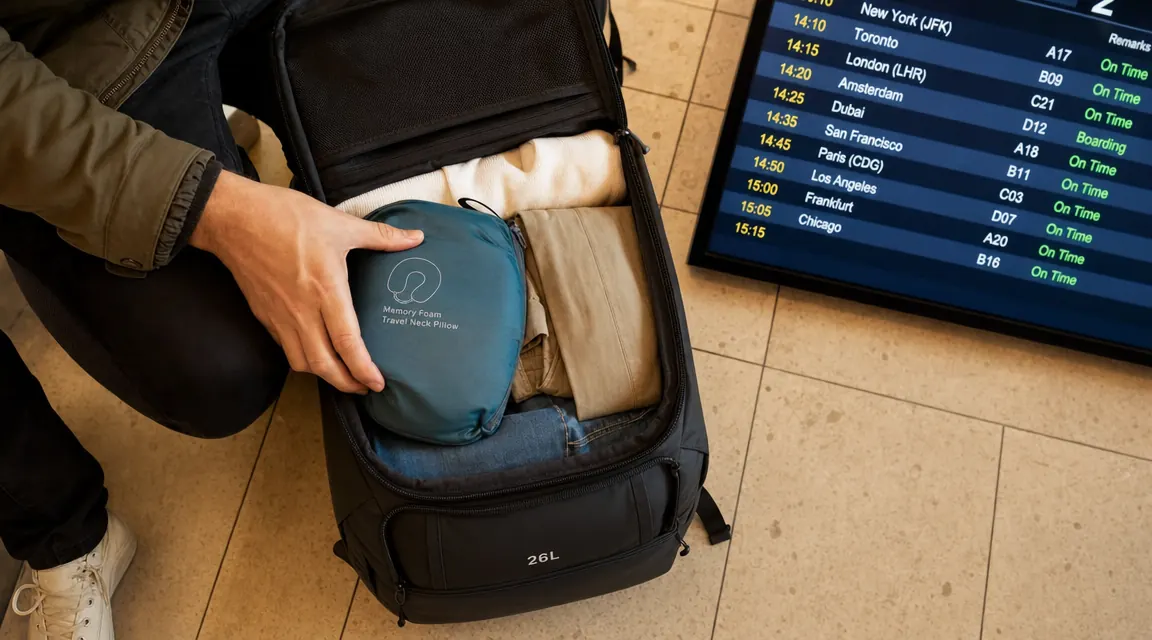
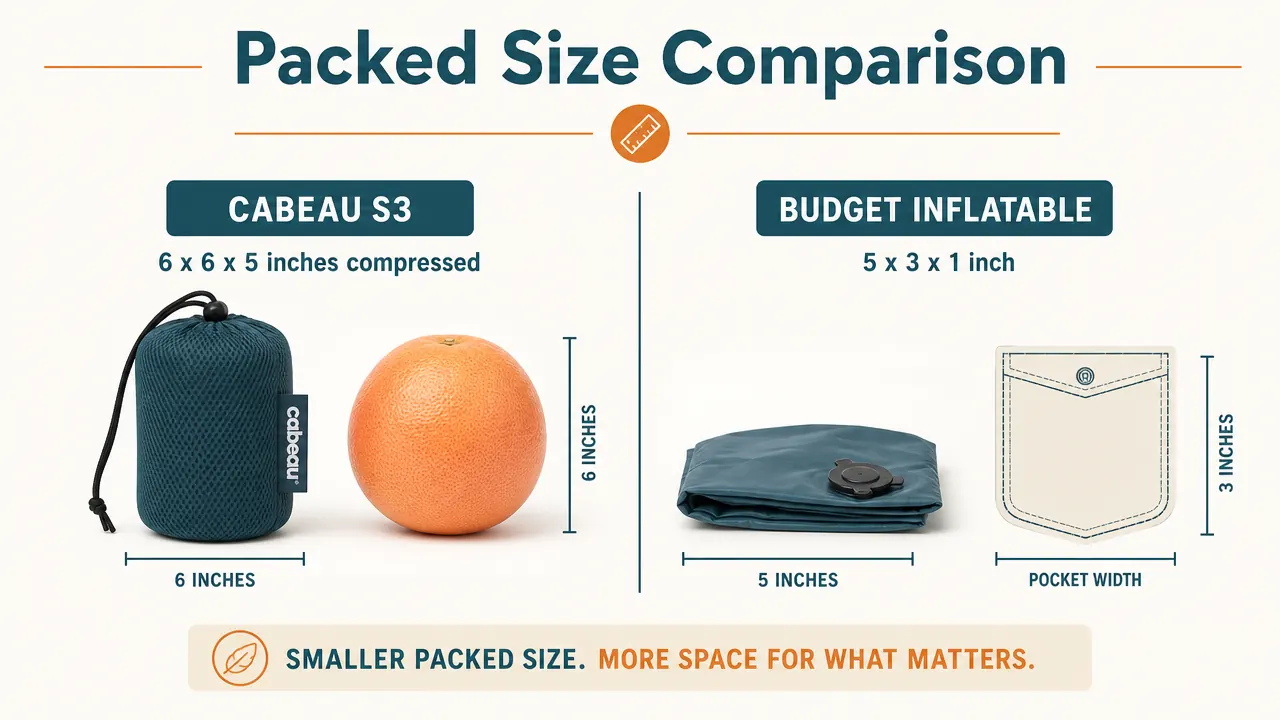
Third limitation: the compressed size is better than uncompressed but still real. Cabeau's own photos show the pillow compressed into a carry bag, and the images make it look smaller than it is in person. Compressed, the S3 is roughly the size of a cantaloupe, maybe slightly smaller. That fits in a jacket pocket on some coats. It does not fit in the side pocket of a 20-liter backpack without taking over the whole compartment. If you are packing genuinely light, this is a calculation you need to make before buying.
Fourth limitation: the price creates an expectation the pillow mostly but not entirely meets. At the mid-range level, you expect a pillow that solves every neck-sleep problem on every flight. What you actually get is a pillow that solves most of the problem most of the time on most flights. That is still better than anything cheaper I have used, but it is worth adjusting your expectations before the first flight so you are not disappointed when it does not turn a fully upright Spirit seat into a business-class pod.
How the Seat Strap System Actually Works in Practice
Because Cabeau makes a big deal out of the strap clips, I want to be specific about the experience. The clips are small plastic hooks attached to thin elastic loops that connect to the back edge of the pillow. You lift the headrest flap on most airline seats, thread the hook through the slot, and snap it in. When it works, the pillow is noticeably more stable. I sat through serious turbulence on a Phoenix to Dallas leg and the pillow stayed against my neck the entire time without my hand catching it.
Where it gets complicated is with budget carriers and older regional aircraft. I was on a CRJ-700 out of Cincinnati where the headrest slots were so narrow that only one of the two clips would fit. Using a single clip still helped versus no clip, but the bilateral stability the system is designed for was not there. On Allegiant flights I have given up on the clips entirely and just used the pillow unclipped, which is still functional. Cabeau could be more forthcoming about this. It is not a defect in the product; it is an honest mismatch between the feature and certain aircraft configurations.
The strap clips are not a gimmick, but they are also not universal. On four out of five flights they work. On one out of five, you are back to using it like any other horseshoe pillow.
The Price Question: Does the Budget Price Point Actually Make Sense?
I have spent time with the math on this. A budget inflatable travel pillow costs roughly eight to twelve dollars and lasts about two to three years before the valve starts leaking. A mid-range memory foam horseshoe runs in the mid-teens and typically shows foam degradation around the eight to twelve month mark with regular travel use. The Cabeau S3 at a higher price point, if it holds up for two or more years of regular flights, comes out to about two dollars per month. That is not an absurd price for something you use on every flight.
The more honest way to frame the price question is this: are the three things that make the S3 different from a fifteen-dollar memory foam pillow worth twenty-five additional dollars to you? Those three things are the seat strap system, the raised chin support, and the quality washable cover. If any of those matter to your specific flying situation, the premium is earned. If you mostly take short domestic flights where you half-doze rather than fully sleep, you can probably get away with spending less.
How It Compares to the Obvious Alternatives
The Trtl Pillow is the most frequently mentioned alternative at a similar price. It looks nothing like a horseshoe: it is a scarf-style wrap with an internal plastic support that holds your neck when you lean to one side. It packs smaller than the S3, which is a genuine advantage for ultralight travelers. It works best for window seat travelers who sleep leaning toward the fuselage. In a middle seat without a fixed surface to lean against, the Trtl requires you to sleep tilted, which is not comfortable for everyone. I have tested both and detailed the comparison in a separate article on this site.
The budget memory foam horseshoes on Amazon at twelve to fifteen dollars are worth mentioning because they are often the starting point people come from. My experience with three different ones over two years of travel: two started losing foam integrity within eight months, and all three lacked any chin support worth the name. They work for short naps on short flights and fail on anything longer. If you are debating between a budget horseshoe and the Cabeau S3, that is where the price difference earns itself most clearly.
What I Liked
- Dense memory foam holds shape and contact for the full duration of a long flight without manual adjustment
- Raised chin support prevents head-drop on upright economy seats, which is the problem most travel pillows ignore
- Washable cover zips off and hand-washes easily, a genuine practical advantage for carry-on-only travel
- Seat strap clips provide real stability on the majority of commercial aircraft headrests
- 4.3-star rating on nearly 2,800 reviews reflects an honest buyer population without signs of artificial inflation
Where It Falls Short
- Memory foam retains heat noticeably after 90 minutes, particularly on daytime flights with warm cabins
- Compressed size is better than uncompressed but still cantaloupe-sized, which competes for real estate in smaller bags
- Seat strap clips do not fit all aircraft headrests, especially on budget carriers and older regional jets
- The mid-range price point sets a high expectation that the pillow meets on most flights but cannot fully deliver on fully upright no-recline seats
Who This Is For
The Cabeau Evolution S3 earns its price for people who fly economy more than six or eight times a year and who regularly hit routes over three hours. If you consistently deal with middle seats, red-eye flights, or transatlantic crossings where real sleep is the difference between arriving functional and arriving wrecked, the S3 makes a clear case for itself. It also makes sense for anyone who has cycled through two or three budget pillows and found themselves dissatisfied every time: this is likely the pillow that ends that cycle.
It is also the right call if you travel carry-on-only and need gear that can take abuse, get washed in a hotel sink, and still show up ready on the next trip. The build quality at nearly a year of use on my own unit shows no meaningful foam degradation, no zipper issues, and no cover pilling. That durability is worth paying for when you are relying on it trip after trip.
Who Should Skip It
If you primarily fly budget carriers where no-recline seats are the default and headrests without slots are the norm, the S3's two flagship features, chin support and seat strap clips, will be at least partially frustrated by the hardware. You will still get a decent memory foam pillow, but you will be paying for features that only partially apply to your situation. Consider whether a well-made fifteen-dollar memory foam option serves your specific routes just as well.
If you are packing under 20 liters and every cubic inch is accounted for, the compressed size of this pillow may be the deciding factor against it. Traveling that lean usually means making hard cuts, and a cantaloupe-sized pillow is often the first thing to go. Travelers in that situation tend to either accept the Trtl's tradeoffs in exchange for the smaller packed footprint, or they skip a dedicated travel pillow entirely and use a rolled-up jacket. I would not judge either choice. The full breakdown of how the S3 stacks up against the Trtl Pillow is linked elsewhere on this site if you want to run that comparison before deciding.
If neck pain after long flights is a recurring problem, the S3 is the one most frequent flyers stop looking beyond.
The Cabeau Evolution S3 ships to most US addresses with standard Amazon delivery. Check current pricing, available colors, and buyer reviews below.
Amazon Check Today's Price on Amazon →